
Synopsis
The transition from traditional subtractive manufacturing to 3D additive manufacturing is no longer a luxury—it is a strategic necessity for global competitiveness. This blog examines how Dynotech’s 100% innovative technology and partnership with Aconity 3D are driving a paradigm shift across six major industrial sectors: Automotive, Architecture, Medical, Aeronautics, Consumer Electronics, and Energy. We detail how metal 3D printing is enabling “part consolidation”—turning complex assemblies into single, lightweight units—and facilitating the use of advanced, difficult-to-machine alloys. By highlighting our 30+ years of experience and successful implementations for over 8 major customers, we demonstrate the real-world impact of additive solutions on speed-to-market and design freedom. Discover how Dynotech is helping Indian manufacturers move beyond the constraints of the past to create high-performance components that define the future of technology.
The Industrial Renaissance: Additive Manufacturing Across the Spectrum
Manufacturing is entering a “post-subtractive” era where the complexity of a part no longer dictates its cost. The Industrial Renaissance: Additive Manufacturing Across the Spectrum At Dynotech, we have spent three decades bridging the gap between global innovation and Indian industrial needs. Today, our 3D additive manufacturing solutions are active across six distinct sectors, helping our 8+ major customers achieve what was once considered impossible.
Aeronautics & Space: Weight Reduction and Part Consolidation
Aeronautics & Space: Weight Reduction and Part Consolidation In an industry where every gram counts, metal 3D printing is a game-changer. By using Laser Powder Bed Fusion (LPBF), we enable the creation of topological optimized brackets and engine components that are 40% lighter than their cast counterparts.
Medical & Healthcare: Patient-Specific Bio-compatible Implants
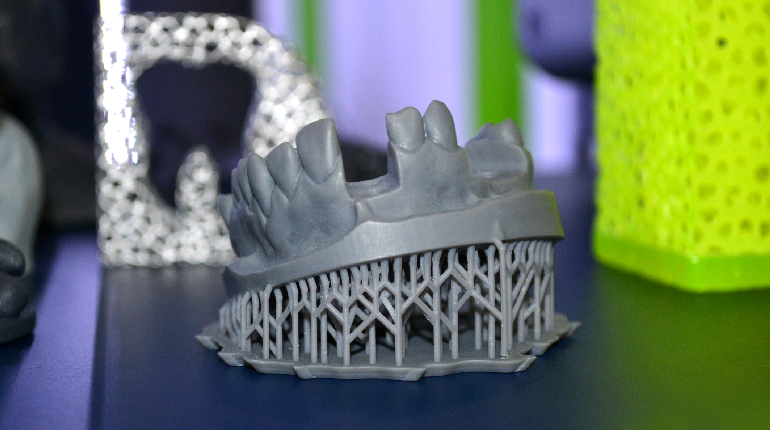
Medical & Healthcare: Patient-Specific Bio-compatible Implants is perhaps the most human-centric application. Our systems can process medical-grade Titanium to produce custom cranial plates and orthopedic implants that match a patient’s unique anatomy, significantly improving recovery times.
Automotive: From Prototyping to High-Performance Production
Automotive: From Prototyping to High-Performance Production The automotive sector is utilizing additive manufacturing for more than just “look-alike” models. We are helping OEMs print functional engine parts and intricate cooling manifolds that improve thermal management in both internal combustion engines and EVs.
Energy: High-Efficiency Heat Exchangers and Turbines
Energy: High-Efficiency Heat Exchangers and Turbines For the energy sector, the ability to print complex internal cooling channels allows for the creation of heat exchangers that are smaller, more efficient, and capable of operating at higher temperatures.
Consumer Electronics & Architecture: The New Design Language
Consumer Electronics & Architecture: The New Design Language From ultra-light laptop chassis to complex architectural nodes for sustainable buildings, 3D printing allows for a level of aesthetic and functional freedom that traditional molds cannot replicate. This flexibility ensures that Indian designers can compete with the best in the world.
The Dynotech Edge: 30 Years of Process Authority
The Dynotech Edge: 30 Years of Process Authority Technology alone is not a solution; it requires context. With 30+ years of experience, Dynotech provides the process know-how to select the right materials and parameters for each of these six industries. Why 100% Innovative Technology is the Only Way Forward As global supply chains become more demanding, adopting 100% innovative technology like Aconity 3D’s modular platforms ensures that your production line is future-proofed against shifting market trends.
Why 100% Innovative Technology is the Only Way Forward
Why Dynotech? We are on a mission to create individual Additive Manufacturing solutions for metal printing. Whether you are in Aeronautics or Consumer Electronics, we bring the best laser technology from around the world to your doorstep, backed by decades of industrial wisdom.
FAQs
How does metal 3D printing help the aerospace industry?
In aerospace, the primary benefit is lightweighting. By using 3D printing to create parts with hollow internal structures or optimized geometries, manufacturers can reduce weight by up to 50%, which leads to significant fuel savings and increased payload capacity.
Are 3D printed medical implants safe for the human body?
Yes. When using bio-compatible materials like Titanium (Ti6Al4V) or Cobalt-Chrome, 3D printed implants are highly safe. They also offer the advantage of “custom fit,” meaning they can be designed to match a patient’s specific bone structure for better surgical outcomes.
Can 3D printing be used for mass production in the automotive sector?
While it started as a prototyping tool, 3D printing is increasingly used for high-performance production parts and specialized tooling. For luxury or racing vehicles, it is already used for end-use parts, and as the technology speeds up, its role in mass production is growing.
What is "part consolidation" in additive manufacturing?
Part consolidation is the process of taking an assembly that previously consisted of 10 or 20 separate parts and printing it as a single, unified component. This reduces assembly time, eliminates fasteners, and removes potential points of failure like leaks.
Is it difficult to switch from traditional machining to 3D printing?
It requires a shift in design thinking, known as Design for Additive Manufacturing (DfAM). Dynotech’s 30+ years of experience means we don’t just provide the machine; we provide the training and support to help your team make this transition smoothly and profitably.