
Synopsis
The clinical success of orthopedic implants is determined by the speed and quality of osseointegration—the structural and functional connection between living bone and the implant surface. This blog explores how laser micromachining, specifically laser-coring and micro-texturing, is revolutionizing the biocompatibility of titanium and cobalt-chrome implants. We detail the shift from traditional grit-blasting and acid-etching to high-precision laser surface functionalization, which creates biomimetic patterns at the micron and nano scales. We examine the technical role of femtosecond lasers in achieving “cold ablation,” ensuring that these complex surface patterns are formed without altering the material’s bulk mechanical properties. By analyzing how micro-channels and “honeycomb” textures promote osteoblast attachment and reduce bacterial adhesion, we demonstrate how Dynotech’s innovative technology is helping medical manufacturers minimize implant rejection and improve long-term patient outcomes for hip, knee, and dental prosthetics.
The Osseointegration Challenge: Engineering for Bone Bonding
The longevity of a hip or knee replacement depends entirely on how well the human body accepts the metal intruder. The Osseointegration Challenge: Engineering for Bone Bonding Historically, implants were given a rough surface through sandblasting to help bone “grip” the metal. However, laser micro-texturing has transformed this into a precise science. By using lasers to etch specific, cell-sized patterns onto titanium surfaces, manufacturers can actually “guide” bone cells to attach faster and more securely than ever before.
Laser Micro-Texturing: Creating Biomimetic Surfaces
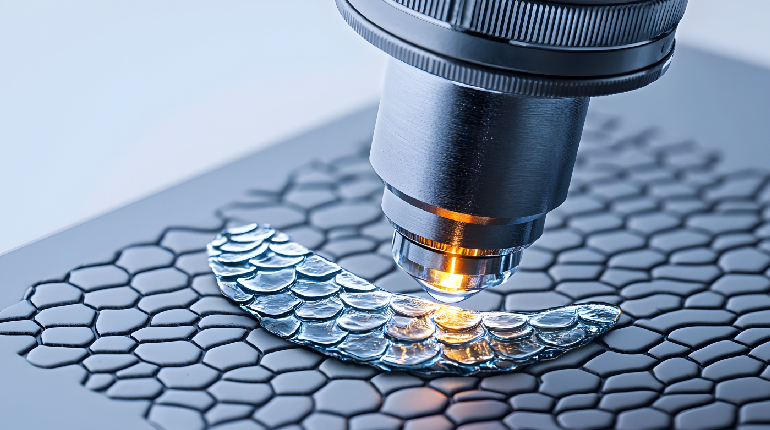
Laser Micro-Texturing: Creating Biomimetic Surfaces involves the creation of micro-grooves, dimples, or “honeycomb” structures that mimic the natural topography of bone. These patterns increase the functional surface area, providing a stable scaffold for osteoblasts (bone-forming cells) to anchor and proliferate.
What is Laser-Coring? Enhancing Porosity and Ingrowth
What is Laser-Coring? Enhancing Porosity and Ingrowth Laser-coring takes this a step further by creating deep, high-aspect-ratio micro-pores or channels into the implant’s collar. These channels allow the bone to grow into the device, creating a mechanical lock that significantly increases the “removal torque” and overall stability of the implant.
The Femtosecond Advantage: Precision Without Heat
The Femtosecond Advantage: Precision Without Heat is the cornerstone of high-end medical manufacturing. Traditional lasers can cause “micro-cracks” or a “re-cast layer” that weakens the metal. Femtosecond lasers deliver energy in ultra-short pulses (one quadrillionth of a second), vaporizing the metal instantly before heat can spread. This “cold ablation” ensures that the intricate micro-textures are pristine and the bulk mechanical properties of the titanium remain uncompromised.
Preventing "Stress Shielding" with Tailored Micro-Porosity
Preventing “Stress Shielding” with Tailored Micro-Porosity is a vital benefit. By using laser-coring to create specific levels of porosity, manufacturers can adjust the “stiffness” (Young’s modulus) of the implant to match human bone more closely. This prevents the metal from carrying all the load, which otherwise causes the surrounding bone to weaken and resorb—a leading cause of implant loosening.
Eliminating Contamination: Cleanliness is Key
Eliminating Contamination: Cleanliness is Key Unlike grit-blasting, which can leave tiny particles of sand or ceramic embedded in the implant, laser texturing is a non-contact, contamination-free process. This ensures a 100% pure surface that reduces the risk of inflammatory responses or implant rejection.
Strategic Benefits for the Orthopedic Industry
Strategic Benefits for the Orthopedic Industry are extensive.
Enhancing Wettability and Surface Energy
Enhancing Wettability and Surface Energy Laser processing significantly improves the “hydrophilicity” (wettability) of the implant. A more “water-loving” surface allows blood and proteins to spread evenly, kickstarting the healing process immediately after surgery.
Reducing Bacterial Adhesion and Infection Risks
Reducing Bacterial Adhesion and Infection Risks Recent studies show that specific laser-machined nano-textures can actually physically rupture bacterial cell walls or prevent them from forming a biofilm, providing a built-in defense against post-operative infections.
Why Dynotech? Elevating MedTech Quality in India
Why Dynotech? Elevating MedTech Quality in India With 30+ years of experience, Dynotech is the bridge to the future of Indian orthopedic manufacturing. We provide the 100% innovative technology needed to move from basic machined implants to high-performance, biomimetic devices. By choosing our laser micromachining solutions, you are ensuring that your products lead the way in biocompatibility, safety, and long-term clinical success.
FAQs
How does laser micro-texturing improve bone bonding?
Laser micro-texturing creates precise, micron-sized patterns (like grooves or dimples) on the implant surface. These patterns provide “contact guidance” for bone cells (osteoblasts), encouraging them to align, attach, and grow more rapidly compared to a smooth or randomly roughened surface.
What is the advantage of "cold ablation" with femtosecond lasers?
Cold ablation means the material is vaporized so quickly that there is no “Heat Affected Zone.” This prevents the formation of micro-cracks or brittle layers in the titanium, ensuring the implant maintains its full structural strength and high fatigue resistance.
Can laser-coring prevent implant loosening over time?
Yes. Laser-coring creates deep micro-pores that allow for “biological fixation,” where the bone grows directly into the metal. This creates a much stronger bond than simple surface attachment, preventing the “stress shielding” and loosening that often lead to revision surgeries.
Is laser texturing better than traditional sandblasting?
Absolutely. Laser texturing is much more reproducible and precise. It also eliminates the risk of surface contamination from blasting media (like sand or alumina), which can cause inflammation. Laser texturing results in a cleaner, safer, and more bio-active surface.
Does laser texturing affect the sterility of the implant?
Actually, it helps. Specific laser-induced nano-textures can be antimicrobial, making it harder for bacteria to stick to the surface and form biofilms. This reduces the risk of infections, which is one of the most serious complications in orthopedic surgery.