
Synopsis
Running high-power industrial femtosecond laser systems continuously in heavy-duty manufacturing environments puts immense stress on optical resonators, cooling systems, and delivery lenses. When thermal degradation or contamination occurs within the optical path, optical beam degradation degrades cutting speed, causes uneven kerf widths, and inflates scrap rates. Integrating FiberCryst‘s Rhapsody single-crystal fiber technology provides inherently high thermal management capabilities, ensuring stable 100W output and pulse energies above 500 J.
To maintain this exceptional performance level over years of multi-shift operation, Dynotech provides dedicated laser maintenance services and local technical support across India. Our certified engineers conduct preventative maintenance contracts, clean sealed optical chambers, and calibrate high-power laser sources on site. Partnering with Dynotech for full sales facilitation, application engineering, and ongoing maintenance guarantees your facility achieves maximum throughput, zero unexpected downtime, and absolute precision across all micromachining workflows.
Table of Contents
- The Hidden Costs of Optical Beam Degradation in Industrial Micromachining
- Thermal Stability Dynamics in Single-Crystal Fiber Architectures
- Preserving Sub-Micron Precision Across Multi-Shift Workflows
- Mitigating Optical Failure via Dedicated Laser Maintenance Services
- Sustaining Industrial Uptime through Preventative Maintenance Contracts
- Eliminating Production Delays with Local Technical Support
- Elevating Precision Manufacturing Performance with Dynotech Authority
- Complete FiberCryst System Sales and Engineering Care Across India
The hidden costs of optical beam degradation in industrial micromachining
In high-precision industrial micromachining, subtle changes in laser output can lead to severe quality failures and financial losses. When ultrafast lasers operate continuously across multi-shift schedules, microscopic dust, oil vapors, and thermal stress begin to take a toll on internal optical pathways. This environmental degradation triggers optical beam degradation, causing the laser’s spatial beam profile (M2) to distort, broaden, and lose peak power density. As the beam profile deteriorates, energy distribution becomes uneven, resulting in incomplete material ablation, erratic kerf widths, and rough sidewall finishes on precision parts. Operators are often forced to manually lower scanning speeds or increase wattage to compensate, which introduces unwanted heat into the substrate and creates recast dross. If left uncorrected, beam degradation inflates scrap rates, destroys expensive workpiece blanks, and stalls daily output targets across automated production lines.
Thermal stability dynamics in single-crystal fiber architectures
Preventing optical distortion at the source requires a laser architecture built specifically to handle high thermal loads without optical fading. Traditional glass-clad fiber lasers suffer from low thermal conductivity, causing severe thermal lensing and mode degradation when driven at continuous high average powers. To solve this fundamental engineering bottleneck, FiberCryst‘s Rhapsody series utilizes single-crystal Yb:YAG fiber rods housed inside active water-cooled jackets. Single-crystal host materials possess exceptionally high thermal conductivity, allowing internal heat to dissipate rapidly before it can distort the optical gain medium. This thermal stability prevents optical beam degradation completely, maintaining a stable 100W infrared output, sub-500fs pulse durations, and pulse energies exceeding 500 J. Because the gain medium retains a pure crystal lattice under intense optical pumping, the laser outputs a pristine, diffraction-limited spatial beam profile through thousands of continuous operational hours.
Preserving sub-micron precision across multi-shift workflows
Maintaining consistent sub-micron precision during high-volume micromachining requires absolute stability across pulse energy, focal spot size, and spatial beam quality. In medical device fabrication, micro-electronics packaging, and precision tool making, even a minor drift in beam geometry ruins tight engineering tolerances. Utilizing single-crystal fiber lasers ensures that the laser focal spot delivers uniform power density from the first second of a shift to the end of a multi-day run. This consistent energy delivery enables clean cold ablation, slicing through hard alloys, tungsten carbide, and delicate polymers without leaving thermal burrs or heat affected zones. Preserving pristine beam quality allows factory managers to run continuous automated workflows with zero mid-process recalibrations, ensuring every part passes strict dimensional quality checks effortlessly.
Mitigating optical failure via dedicated laser maintenance services
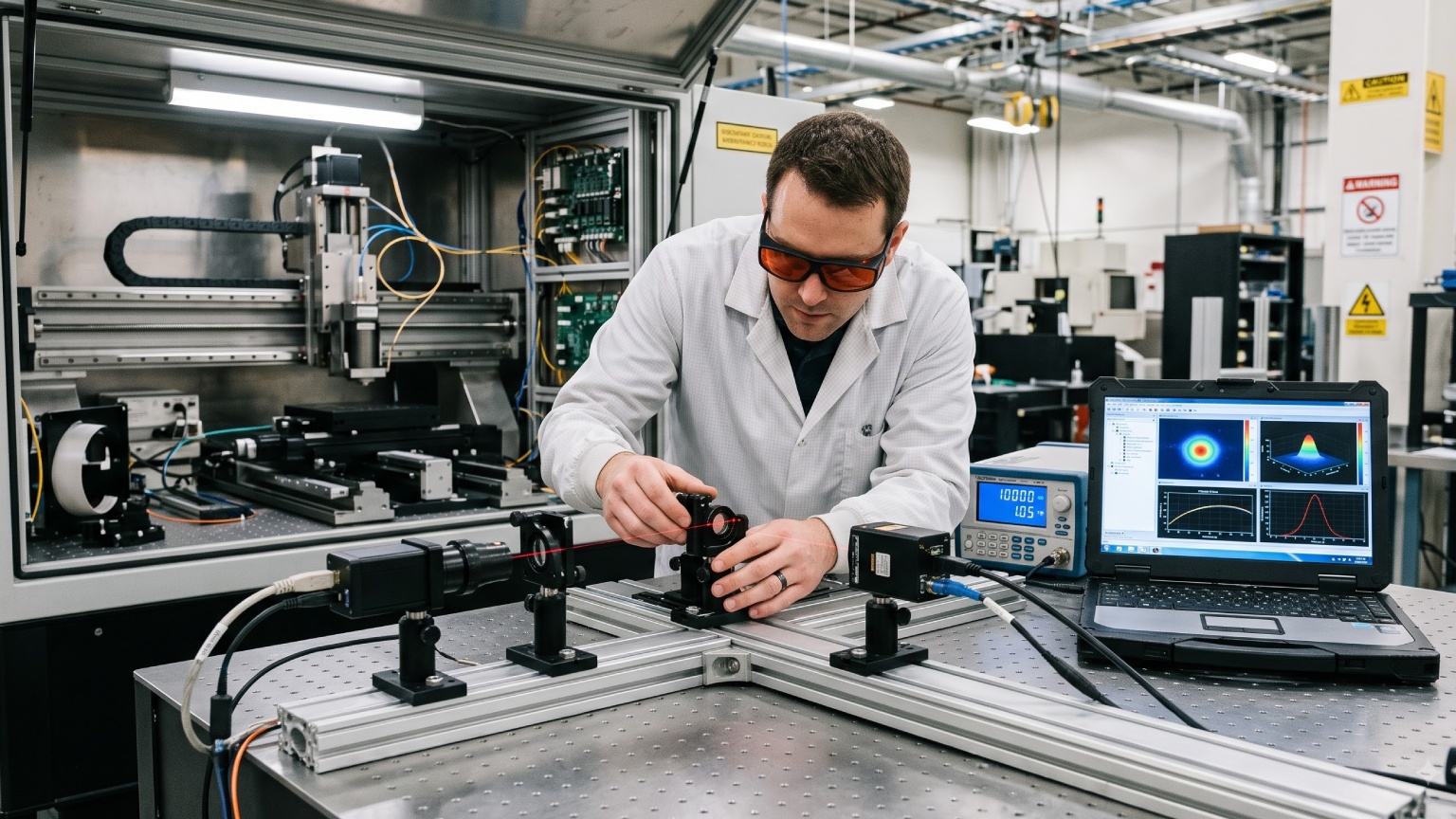
While advanced single-crystal architectures provide inherent thermal resilience, external delivery optics, scan mirrors, and protective windows remain vulnerable to ambient shop floor contamination. Microscopic debris or oil film settling on a high-power delivery lens absorbs laser energy, causing localized thermal blooming that distorts the beam profile and can crack expensive optics. Dynotech delivers specialized, dedicated laser maintenance services throughout India to keep your optical delivery train operating in peak condition. Our certified service engineers utilize calibrated beam profilers, optical spectrum analyzers, and laser power meters to diagnose beam propagation dynamics on site. Performing routine alignment checks, cleaning enclosed optical pathways, and replacing degraded protective windows prevents optical beam degradation before it impacts your production quality.
Sustaining industrial uptime through preventative maintenance contracts
Securing long-term machine availability in high-throughput manufacturing plants demands a proactive equipment care model rather than reactive emergency repairs. Dynotech offers structured preventative maintenance contracts designed specifically to meet the rigorous uptime targets of Indian industrial manufacturers. Our comprehensive preventative maintenance contracts include scheduled site visits by certified service engineers to inspect beam delivery pathways, test laser diode output power, monitor cooling fluid purity, and calibrate galvo scanning head interfaces. Proactive care ensures that laser resonators, pulse compressors, and chiller units operate strictly within factory-certified engineering tolerances. Implementing structured preventative maintenance contracts eliminates unexpected equipment breakdowns, extends the working life of capital laser hardware, and protects your manufacturing cash flow.
Eliminating production delays with local technical support
In continuous, multi-shift manufacturing, an unexpected laser fault or optical misalignment can bring automated production lines to a sudden halt, risking heavy delivery default penalties. Relying on overseas field service technicians leads to frustrating, multi-week equipment delays while waiting for international travel arrangements and customs clearance for spare parts. Dynotech eliminates this operational risk by delivering rapid, highly responsive local technical support across all major industrial regions in India. Our certified field service team carries specialized optical diagnostics tools and maintains local inventories of critical spare parts, including optical couplers, power supplies, and control boards. When a technical issue occurs, our engineers deploy directly to your facility to conduct optical realignments, module repairs, and system recalibrations. Having reliable local technical support ensures your manufacturing floor stays fully operational, keeping client delivery commitments secure.
Elevating precision manufacturing performance with Dynotech authority
Building a competitive, world-class precision manufacturing infrastructure in India requires a trusted technology partner with deep technical authority and multi-disciplinary experience. Dynotech stands as India’s premier high-technology integrator, bringing over 14 years of specialized expertise in lasers, semiconductors, precision machining, and production efficiency to every client partnership. We bridge the gap between global technology pioneers like FiberCryst and local factory floor execution. Our comprehensive service model covers hardware sales facilitation, custom integration consulting, cleanroom tool setup, operator training, and ongoing technical support. By working closely with your manufacturing leadership, Dynotech helps your facility eliminate optical beam degradation, lower scrap rates, and maintain strict compliance with global quality standards. We are fully committed to empowering Indian manufacturers to achieve long-term commercial success.
Complete FiberCryst system sales and engineering care across India
Our strategic collaboration with FiberCryst allows us to bring world-leading single crystal fiber lasers, femtosecond amplifiers, and high-power laser engines directly to Indian industrial manufacturers and scientific R&D centers. Dynotech’s unique value proposition lies in our complete local support—we manage hardware sales facilitation, application engineering, factory installation, and ongoing maintenance under a single local contract. Beyond single-crystal laser sources, our wide industrial portfolio includes ultrafast femtosecond lasers, supercontinuum light sources, precision laser welding systems, and real-time process monitoring tools built for high-precision manufacturing. We maintain fully stocked spare parts warehouses and deploy certified field technicians across all major industrial manufacturing hubs in India to provide immediate technical support. Partnering with Dynotech guarantees a future-proof, high-precision manufacturing setup that drives long-term commercial growth. Contact our technical team today to protect your micromachining lines with world-class laser maintenance services.
FAQs
What are the primary root causes of optical beam degradation in high-power industrial laser systems?
The primary root causes of optical beam degradation include airborne dust contamination on optical lenses, thermal lensing within the laser gain medium, and the aging of pump laser diodes. During high-power continuous operation, microscopic particles settling on exposed optical windows absorb laser energy, creating localized hot spots that distort the light beam. Inside conventional fiber resonators, poor thermal dissipation alters the refractive index profile of the fiber core, degrading the spatial beam quality (M2). Over time, this thermal and physical stress causes power density loss, uneven beam shaping, and poor cutting performance across the workpiece surface.
How do FiberCryst single-crystal fiber lasers prevent internal thermal lensing during continuous high-wattage operation?
FiberCryst single-crystal fiber lasers prevent thermal lensing by replacing traditional amorphous silica fiber cores with robust single-crystal Yb:YAG rods housed inside active water-cooling jackets. Single-crystal host materials possess exceptionally high thermal conductivity compared to standard glass fibers, allowing heat generated during optical pumping to conduct rapidly into the surrounding liquid chiller loop. This superior thermal management maintains a uniform crystal lattice profile across the gain medium even under intense 100W pumping. Preventing localized heat accumulation ensures that the laser maintains a pure, diffraction-limited spatial beam profile and stable pulse energies above 500 J without optical distortion.
How does optical beam degradation directly impact kerf width consistency and scrap rates in precision micromachining?
Optical beam degradation impacts kerf width consistency by altering the focal spot geometry and lowering the peak power density of the laser beam. When the beam profile distorts, the energy distribution across the cutting spot becomes uneven, causing the laser to melt rather than cleanly ablate material. This energy loss creates wider, irregular kerf lines, heavy edge dross, and thermal micro-cracking along precision cut paths. In high-tolerance industries like medical device manufacturing or micro-electronics, these dimensional variations fail strict optical quality inspections, leading to high part scrap rates and wasted raw materials.
What specific diagnostic procedures are performed during a site visit under Dynotech's laser maintenance services?
During a site visit under Dynotech’s laser maintenance services, certified field engineers execute a comprehensive series of diagnostic tests using high-precision optical measurement instruments. They measure spatial beam quality (M2), beam divergence, and focal spot stability using CCD beam profilers. Engineers test laser output power stability across full operating ranges, inspect delivery fiber end-facets under optical microscopes for surface contamination, and verify pulse energy output. Additionally, they clean enclosed optical pathways, calibrate active liquid chiller cooling loops, and align beam delivery mirrors to restore optimal focus and spatial performance.
Why are structured preventative maintenance contracts essential for medical device and micro-electronics manufacturers?
Structured preventative maintenance contracts are essential because medical device and micro-electronics manufacturing require sub-micron cutting accuracy and 100% process repeatability under strict regulatory audits (such as ISO 13485). In 24/7 continuous manufacturing lines, minor optical drift, lens contamination, or chiller temperature variations can cause undetected quality defects across large product batches. Scheduled preventive maintenance visits by certified service engineers ensure that optical alignment, pulse energy, and cooling parameters are calibrated regularly. This proactive care prevents sudden equipment breakdowns, preserves sub-micron tolerances, and protects manufacturers from expensive product recalls.
How does localized technical support shorten emergency repair timelines for Indian manufacturing facilities?
Localized technical support shortens emergency repair timelines by deploying certified field service engineers directly to your facility within hours of a reported equipment fault. Relying on overseas manufacturers for technical assistance often results in weeks of costly factory downtime while waiting for international travel, visa approvals, and customs clearance for imported spare parts. Dynotech maintains fully equipped local technical service centers and stocked spare parts warehouses across major industrial regions in India. Our engineers arrive on site equipped with diagnostic profilers and replacement components to perform immediate optical realignments, module repairs, and system recalibrations, restoring full production rapidly.