
Synopsis
Modern semiconductor manufacturing facilities across India require extreme optical precision to inspect ultra-fine silicon structures without introducing thermal damage or signal noise. Relying on legacy monochromatic light sources often limits inspection depth and resolution, creating severe operational testing bottlenecks during high-volume production. Upgrading your inspection lines to supercontinuum white light lasers provides a broad, high-brightness spectral output that drastically improves wafer metrology accuracy. Through Dynotech’s expert local optics consulting, Indian semiconductor plants can seamlessly integrate these advanced fiber platforms into existing optical inspection setups.
Furthermore, utilizing low-noise fiber lasers ensures ultra-repeatable measurements and stable signal processing across continuous shifts. To protect your investment, Dynotech provides full localized installation, preventative maintenance contracts, and rapid technical support across India’s growing tech hubs. This comprehensive support helps semiconductor facilities maximize throughput, lower wafer scrap rates, and maintain 100% processing accuracy. Partnering with a trusted local process expert ensures your optical infrastructure remains future-proof, highly reliable, and ready to meet global semiconductor standards.
Table of Contents
- Testing Bottlenecks in Modern Semiconductor Wafer Inspection
- Broad-Spectrum Light Mechanics in Supercontinuum Systems
- Maximizing Signal Precision with Low-Noise Fiber Lasers
- Tailored Machinery Integration through Local Optics Consulting
- Protecting Capital Equipment via Preventative Maintenance Contracts
- Eliminating Downtime with Localized Technical Support
- Driving Semiconductor Growth with Dynotech Expertise
- Complete Sales and Engineering Support Across India
Testing bottlenecks in modern semiconductor wafer inspection
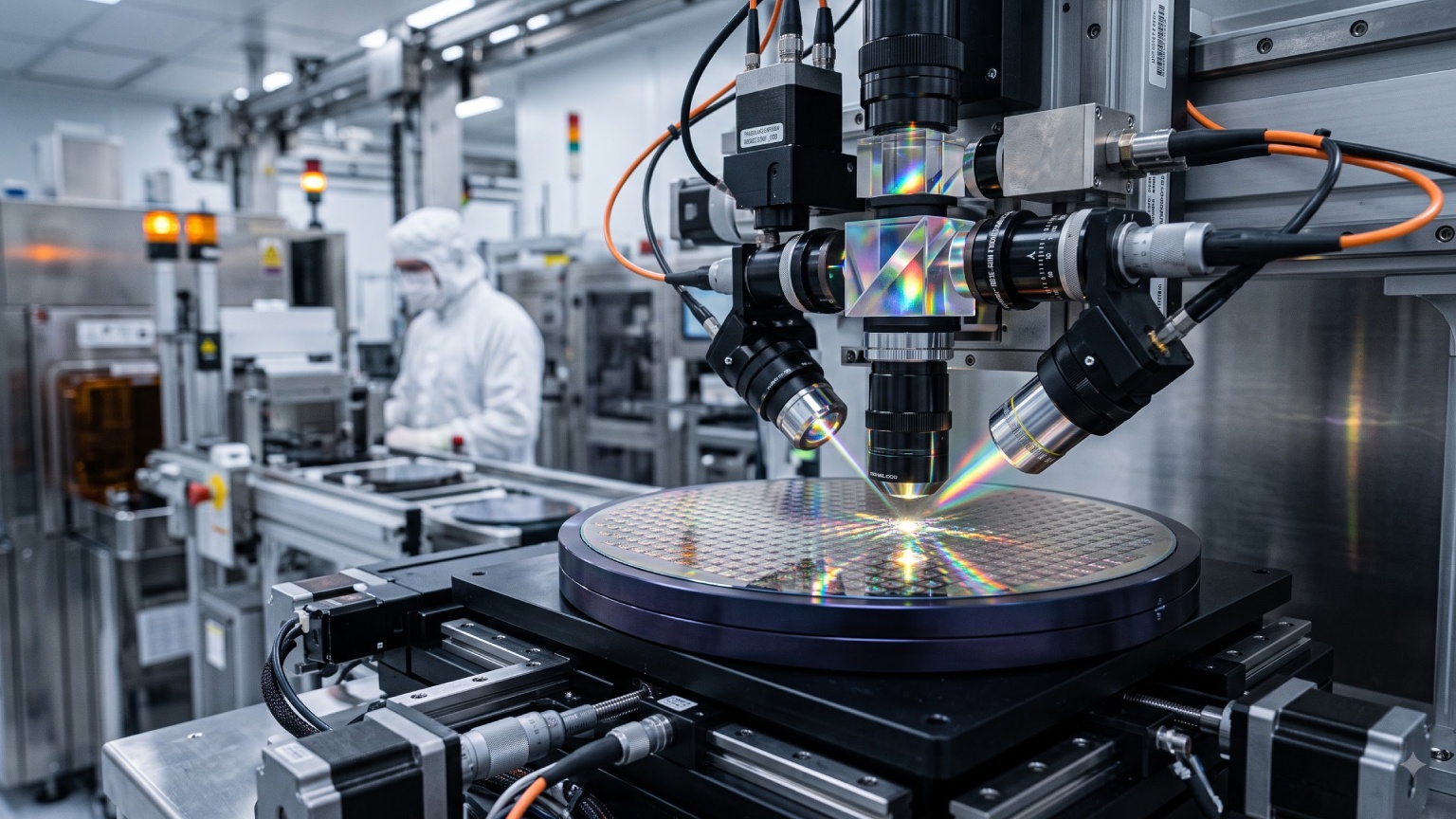
As silicon geometry scales down to sub-nanometer nodes, modern semiconductor manufacturing operations across India face massive challenges in quality control and wafer metrology. Conventional inspection setups that use narrow-band, monochromatic laser diodes struggle to detect deep-layer defects, pattern overlay errors, and complex film thickness variations. These legacy light sources lack the broad spectral output required for high-resolution scatterometry and optical coherence tomography. When metrology tools fail to catch sub-surface micro-cracks or layer misalignments early, defective wafers move down the assembly line, resulting in catastrophic yield losses during final packaging. Furthermore, slow measurement acquisition times create severe operational testing bottlenecks that choke overall cleanroom throughput. To remain competitive in the global electronics market, Indian fabs must upgrade their optical testing infrastructure with high-luminance, broad-spectrum light sources that deliver instant, multi-wavelength measurement capabilities.
Broad-spectrum light mechanics in supercontinuum systems
To overcome the physical limitations of narrow-band light sources, forward-thinking semiconductor facilities are integrating supercontinuum white light lasers as their primary optical inspection engine. These advanced light sources operate by launching ultra-short laser pulses through specialized photonic crystal fibers, expanding a single laser wavelength into a continuous, high-brightness spectrum spanning from the ultraviolet to the short-wave infrared range. Supercontinuum white light lasers deliver the spatial coherence and high directional brightness of a standard laser combined with the broad spectral range of a super-luminescent diode. This unique combination allows automated optical inspection tools to analyze multiple film layers simultaneously with sub-micron spatial resolution. Shifting to broad-spectrum light sources accelerates measurement speeds, reduces optical interference artifacts, and provides cleanroom engineers with the high-resolution data needed to optimize silicon processing steps in real time.
Maximizing signal precision with low-noise fiber lasers
Achieving absolute signal repeatability during high-speed wafer scanning requires a light source with exceptional amplitude stability and low intensity noise. Utilizing low-noise fiber lasers ensures that delicate optical detectors receive a smooth, ultra-stable beam without intensity fluctuations that distort signal processing algorithms. In high-sensitivity ellipsometry and wafer defect mapping, even minor laser power drift can lead to false defect reports or missed pattern anomalies. By integrating low-noise fiber lasers, inspection tools maintain a high signal-to-noise ratio across multi-hour scanning shifts. This high level of optical stability allows cleanroom technicians to inspect ultra-fine circuit features reliably without running repetitive calibration cycles. Eliminating signal noise helps semiconductor plants lower part reject numbers, protect expensive silicon inventory, and maintain continuous, high-yield manufacturing schedules.
Tailored machinery integration through local optics consulting
Successfully introducing advanced supercontinuum white light lasers into existing cleanroom toolsets demands deep application engineering and tailored local optics consulting. Fabs cannot simply drop a high-power fiber laser engine into an older inspection rig without adjusting beam expanders, optical filters, and signal acquisition hardware. Dynotech provides specialized local optics consulting, working side by side with your process engineering team to design custom optical trains, match beam divergence profiles, and configure automated alignment systems. Our expert consulting ensures that the light source interfaces seamlessly with your existing scatterometry and defect mapping tools without causing thermal blooming or optical element misalignment. Having access to experienced local application specialists speeds up system integration, lowers technical risks, and ensures your hardware investment delivers immediate productivity gains.
Protecting capital equipment via preventative maintenance contracts
Maintaining pristine optical performance in a 24/7 semiconductor fab requires proactive care and structured equipment protection programs. Deploying high-power supercontinuum white light lasers alongside specialized photonic crystal fibers demands routine optical surface cleaning, power calibration, and thermal management checks. Dynotech offers comprehensive preventative maintenance contracts tailored specifically to the high-uptime requirements of Indian electronics manufacturers. Our structured preventative maintenance contracts include scheduled technician visits to inspect optical couplings, test laser diode power profiles, clean enclosed beam delivery pathways, and replace aging cooling components before they fail. Taking this proactive maintenance approach prevents unexpected laser shutdowns, extends the operational lifespan of sensitive photonic components, and protects your capital infrastructure from expensive hardware repairs.
Eliminating downtime with localized technical support
In high-volume semiconductor manufacturing, cleanroom downtime translates directly into massive financial losses and delayed customer shipping schedules. If a fiber laser source experiences a control fault or optical drop, waiting weeks for overseas factory technicians to arrive is completely unacceptable. Dynotech resolves this operational vulnerability by providing fast, localized technical support across all major industrial technology hubs in India. Our certified field service team carries specialized diagnostic instruments and maintains local inventories of critical spare parts, including replacement fibers, power supplies, and control modules. When an operational issue occurs, our engineers deploy directly to your site to perform immediate troubleshooting, optical alignments, and component swaps. Having dependable local technical support ensures your fab stays operational, protecting your delivery schedules and maintaining high client satisfaction.
Driving semiconductor growth with Dynotech expertise
Establishing a competitive semiconductor manufacturing ecosystem in India requires a trusted technology partner with deep process authority and decades of industrial experience. Dynotech stands as India’s premier high-technology integrator, bringing over 14 years of specialized expertise in lasers, semiconductors, precision machining, and production efficiency to every client partnership. We bridge the gap between world-leading global optics manufacturers like NKT Photonics and local factory floor execution. Our comprehensive service model covers every stage of the technology lifecycle, including hardware sales facilitation, custom optical consulting, cleanroom integration, operator training, and ongoing system maintenance. By working closely with your engineering leadership, Dynotech ensures your facility achieves maximum throughput, lowers total scrap rates, and optimizes cost per wafer. We are fully committed to empowering Indian manufacturers to step confidently into global semiconductor leadership.
Complete sales and engineering support across India
Our strategic collaboration with NKT Photonics allows us to deliver cutting-edge supercontinuum white light lasers, low-noise fiber lasers, and specialty photonic crystal fibers directly to Indian industry and research labs. Dynotech’s unique value proposition lies in our complete turnkey support—we manage international procurement, cleanroom delivery, optical calibration, and long-term service under a single contract. Beyond advanced metrology light sources, our wider portfolio includes high-power industrial laser welding platforms, ultrafast micromachining systems, and automated process monitoring tools built for cleanroom applications. We provide structured preventative maintenance contracts, local application engineering, and 24/7 technical support to keep your production lines running without interruption. Partnering with Dynotech means building a future-proof, high-yield manufacturing setup that drives long-term profitability. Contact our engineering team today to upgrade your semiconductor inspection lines with world-class supercontinuum technology.
FAQs
Why are supercontinuum white light lasers superior to conventional monochromatic light sources for semiconductor wafer inspection?
Supercontinuum white light lasers are far superior because they combine the broad spectral range of a white light lamp with the directional brightness and high spatial coherence of a laser. Conventional monochromatic light sources emit only a single wavelength, limiting their ability to inspect complex multi-layer silicon structures or measure varying film thicknesses in one pass. Supercontinuum systems generate a continuous spectrum from ultraviolet to infrared, allowing automated optical tools to scan multiple layers simultaneously. This broad-spectrum capability drastically improves defect detection resolution, speeds up measurement cycles, and reduces optical interference noise during wafer scatterometry.
How does local optics consulting accelerate the integration of advanced fiber laser light sources into existing cleanroom equipment?
Local optics consulting accelerates system integration by providing custom application engineering and optical design support directly on site. Installing an advanced fiber light source into an existing inspection rig requires matching beam delivery profiles, designing custom filter wheels, and calibrating high-speed sensor interfaces. Expert consultants analyze your specific metrology requirements and modify the optical path to prevent thermal distortion and signal loss. This hands-on guidance removes setup trial and error, prevents damage to sensitive photonic components, and ensures your upgraded metrology equipment operates at peak performance immediately upon installation.
What role do low-noise fiber lasers play in maintaining signal accuracy during continuous automated wafer scanning?
Low-noise fiber lasers play a critical role by delivering a highly stable, uniform light output free from amplitude variations and intensity noise. During high-speed wafer scanning, optical sensors measure minute changes in light scattering to detect sub-micron pattern defects and thin-film variations. If the light source exhibits intensity noise or power drift, the signal processing software can generate false defect reports or miss actual structural flaws. Utilizing low-noise fiber lasers maintains a high signal-to-noise ratio across continuous multi-hour production shifts, ensuring reliable measurement repeatability and protecting valuable silicon wafers from being misclassified.
What specific service checks are included in Dynotech's preventative maintenance contracts for cleanroom laser systems?
Dynotech’s preventative maintenance contracts include a comprehensive series of technical checks designed to keep cleanroom laser systems operating at maximum efficiency. Our certified field engineers inspect and clean all enclosed optical interfaces, calibrate laser diode output power, and test system beam profiles for spatial degradation. We also verify the performance of active liquid cooling loops, inspect power supplies for electrical stability, and replace aging optical fibers or filter components before they fail. Performing these regular preventive maintenance checks prevents unexpected laser shutdowns, maintains tight measurement tolerances, and extends the operational lifespan of your capital equipment.
How does having access to localized technical support lower operational risks for Indian semiconductor manufacturing plants?
Having localized technical support lowers operational risks by providing immediate, on-site service response and rapid spare parts availability whenever an equipment fault occurs. In high-volume semiconductor manufacturing, cleanroom downtime can cost thousands of dollars per hour in lost throughput and spoiled wafer batches. Relying on overseas technicians often leads to long equipment outages while waiting for service visits and international spare parts shipments. Local technical support teams arrive at your facility within hours, carrying calibrated diagnostic tools and local inventory to fix optical faults, replace modules, and restore full production instantly.
What types of photonic crystal fibers are utilized inside supercontinuum white light lasers to expand optical spectrum bandwidths?
Supercontinuum white light lasers utilize specialized microstructured photonic crystal fibers engineered with a precise pattern of microscopic air holes running along their entire length. These air holes create a tight light confinement core that dramatically increases non-linear optical interactions as high-power laser pulses pass through. Processes like self-phase modulation, four-wave mixing, and Raman scattering instantly broaden the initial single-wavelength pulse into a continuous broad spectrum. Using these advanced photonic crystal fibers allows the system to achieve high spectral brightness and stable directional output across a broad range of optical wavelengths.